

I want to begin with a theological premise, because the essay does not work without one. Grace, in the tradition I was raised inside, is the name we give to what arrives when we have not earned it and could not have asked for it because we did not yet know what to ask. It is unearned, particular, and it tends to show up as a person rather than as an idea.
What follows is about the people grace sent me.
A mother, I have come to understand, is a person. Mothering is something else. Mothering is the tendered love and care you can feel: the hand that steadies you, the voice that softens your fears and calms your nerves, the presence that sees the challenges and the cracks and remains. Mothering is shelter, witness, nourishment, correction, steadiness, warmth, protection. It is helping a child feel less alone inside their own life. It is, also, emotional translation: the work of helping a child understand what they are feeling at the moment they cannot yet name it. The two, the person and the act, are not the same thing, and a great deal of what I have spent my adult life learning is that they do not always arrive together. A title alone does not raise someone. Tenderness, willingness, sacrifice. These are some of the elements that go into the act. Not into having a child. Into mothering one.
Mothering is the act through which someone makes another person’s survival possible. Whoever did that for you, however they did it, in whatever shape it took, that is what the day is for, if the day is to be for anything at all.
Mothering came to me. It came to me by grace. The women through whom it arrived are the subject of what follows.
My biological mother is alive. We are estranged.
I want to begin with her, with the care she is owed, before I describe what her absence produced. Anything less would be untrue to the love I still carry for her. Her own story precedes mine.
She had me when she was nineteen. She was, herself, a vulnerable person, someone whose childhood had not finished happening to her yet, whose traumas were still actively haunting her at the moment she became responsible for someone else’s. The relationship between us was never able to grow into what it was meant to be. I do not say that as accusation. I say it as the structural fact it is. There are people who become parents before their own personhood has had a chance to consolidate, and the love they have for their children is real, and the capacity to deliver that love through the daily acts of mothering is not always there. Both things are true. The truth requires holding both.
What I experienced, as a child, was a cycle. She would leave. The absences would lengthen. Then she would return, and I, having no other framework to make sense of what was happening, would receive her return not as another chance, which is how I would describe it now, but as the natural order being restored. I had my mother again. That was what mattered. She would make my world feel magical when she returned. She would talk about her and me being a team against the world. I believed her, every time, until eventually I realized the chaos was by her doing. As a young child, I viewed my mother as my God, and the way you greet the return of God is not with the conditions or skepticism of an adult. You greet it with the relief of a person whose universe has been put back together. I would lovingly give her another chance, every time, because I did not understand it as giving her another chance. I understood it as having my mother again.
My love for my mother was unconditional until it wasn’t. I held that posture longer than the cycle should have allowed. I held it through the absences becoming longer. I held it through the visits becoming more chaotic. I held it past every reasonable point at which a person would have closed the door, because the door was load-bearing for me. I never stopped wanting her to walk through it. The cauterization came late. I was thirty years old. It came in events I witnessed during my most vulnerable moments. What closed the door was not the cycle. It was something else. My mother never forgave me for the transition.
The stability promises never held.
She never stayed long. The pattern was its own kind of weather, predictable in its instability, and I learned to brace for the leaving even while the returning was still happening. In those absences, when God knew how much I cried and worried, wondering where my mom was, whether I would ever see her again, the fear and the abandonment did the work of shaping me. That work is not finished.
This is what moved my grandparents to seek legal guardianship of me. They remained my guardians for the duration of my upbringing.
My mother’s love, when it arrives, is the kind of love that hurts. She has never grasped how much. The absence of the relationship is its own presence on this day every year.
So I am the kind of orphan whose parents are still alive.
The condition has a specific texture: it is the feeling of standing in a card aisle and realizing none of the cards are for you.
I have come to understand, slowly and not without resistance, that this is what I am. The word orphan is not technically accurate. Both my mother and my father remain in the world. But it is the only word I have found that names what is true. My mind, in its own quiet wisdom, has rewired itself.
I still love her. I love a version of her that exists in my heart, the version who could have walked through the door I held open. The woman I call mother is the one who never stopped choosing me.
And so I was mothered. That is the saving fact at the center of this essay. The mothering arrived through other women, sent, I have come to believe, by the same God who knew how much I cried in the absences. Grace took embodied form, and the form was women who saw me.
The two women in my family who did the work of mothering me, in my childhood, were both my grandmothers.
Mimi, on my father’s side, was my legal guardian and my primary caregiver. I grew up in her house. Nana, on my mother’s side, did something I did not have the vocabulary to recognize until much later: she bridged the gap her own daughter could not fill.
Both of them were what I would now call true matriarchal women. They carried the unconditional love and selflessness that you sometimes hear described in eulogies and rarely encounter in life. Their wisdom I have always latched onto like it was law. The things they said, when they said them, became operational rules in my interior life. They are still operational. They will be operational long after I am gone.
What Mimi did was the daily building. She was the one who got me up and got me to school and got me fed and got me through the parts of being a child that nobody writes about because they are too small to write about and too large to do without. She was the one whose voice called me from the other room. She was the one whose hand I reached for without thinking. She was the place I recognized as home before I had the language for what home meant. She was my sanctuary. Under her love, I thrived. She is the foundation everything else in my life stands on, and she is the one I am most still grieving. What I will say here is this: Mimi mothered me by being there, every day, for twenty-nine years, until she died.
Nana did something different, and I want to name it specifically, because what she did is the reason I have any spiritual life at all.
I was a child whose circumstances did not always make sense. The absences of my mother, the chaos of the visits, the shape of a household that the world was not set up to recognize as a household, none of it was easily explainable to a child also trying to make sense of God. There is a version of that childhood in which I would have done what many children in those circumstances do: I would have concluded that God was rejecting me. Or that I was unworthy of grace. Or that God was the one causing the bad things to happen, and that He could be blamed for them.
Nana did not let any of those conclusions take root. She did not lecture me away from them. She did something quieter and more skilled: she let me ask.
She let me ask all the questions a curious child has. And the further questions of a child trying to figure out the mystic and magical elements of faith. And the further questions still of a child trying to master prayer, because there were so many people to pray for and so many things to pray about. She protected the inquiry. She kept the relationship between me and God open at the precise moments my circumstances would have closed it.
What she gave me, by doing this, was the language for something I had been carrying since I could remember. I have carried the Holy Spirit with me from the earliest time of my existence I can locate. Nana did not put the Spirit there. The Spirit was there. What Nana did was give me the awareness that the Spirit was there, and the permission to recognize what that presence had been doing all along.
In her own way, the Holy Spirit mothered me as well. I do not say this lightly, and I am aware that some readers will read past this sentence and others will stop on it. I am writing for both. What I mean is that the Spirit took the unexplainable, confusing material of a child’s life and showed me how to navigate it. How to find a sanctuary inside it. I felt protected. I felt guided. I have felt protected and guided ever since. That is what mothering, in its essential form, is. The Spirit was, and continues to be, one of the mothers I am here to name.
Nana is the one who taught me to recognize Her.
Mrs. Gary was my fourth-grade teacher. What she did for me is not what teachers are usually credited with.
I was, when she got me, the quiet kid at a corner desk with glasses and braces and two large bucked teeth, very much insecure. I was the only person in my class with braces. I felt ugly. Until that year, I had been more content and relaxed at school than at home, except when I knew home was Mimi and Bumpa, which most of the time it was. School was the place I had learned to be in the absence of the person I most wanted home to mean.
Mrs. Gary saw my insecurities and my lack of confidence and my shyness, and she actively worked with me to come out of my walled comfort zone, because she saw potential in me I had not seen in myself. She told me a secret I would later come to appreciate. Getting braces now, she said, meant by high school I would have perfect teeth and be done, and I could enjoy the rest of my life with a great smile. A lot of kids will get braces, she added, but I had been given a head start. Those sorts of intentional comfort words stayed with me longer than I think she thought they would. To me they registered as genuine care, and that is what lasted.
What she did, by seeing me, was give me permission to thrive in the place I could control. By the end of fourth grade I was an active member of Cub Scouts on my way to earning my Arrow of Light, my class’s 4-H president, an identified gifted student invited to attend a magnet school, and a kid who had developed a serious interest in space, the Hubble Space Telescope especially. I attended a Vanderbilt presentation on Mars that landed me in the local newspaper. I was building a life inside the school day that the home day could not touch. School became the place I could be elsewhere, and the place I could be wanted. Mrs. Gary gave me my worth and value.
I want to be precise about what that sentence means. She did not give me self-esteem. She did not give me confidence in some abstract psychological sense. She gave me worth: a sense that I was a person whose existence was something the world had reason to be glad about. And value: a sense that what I could do mattered. Those two gifts are not the same. They are also not the gifts a teacher is paid to give. They are the gifts a mother gives, when there is one available to give them. In my case, when I was ten years old, in a public school classroom in Tennessee, the mother available to give them was Mrs. Gary.
There is one more woman the essay needs from those years, and I have been delaying her, because what I owe her is harder to give than acknowledgment.
Her name is Cathy D. She was my stepmother for a while. She is no longer married to my father. She is no longer in my life in any active way. She is a woman I undervalued for the entire duration of the time she was assigned to me. I want to honor her now, in public, on the day designed for the work of honoring women like her, because I did not honor her then and the failure to do so is one of the things I carry.
The family Cathy married into had a long pattern of not keeping the people who married in: nine divorces among my grandparents’ three children over three decades. Outsiders would join the family, and then they would depart, usually in the dramatic exit my family had grown accustomed to. Cathy knew the family she was joining. She joined it anyway. For the years she was in it, she was the responsible, reliable, undervalued keystone figure on the side of the family I came up inside. I can admit that now. She held the architecture together.
What she did for me, specifically, took a form I could not see at the time because the form was negative space. She kept my father in line. She kept him under control most of the time. She absorbed what would otherwise have been my problem to absorb, and she did it without asking me to thank her, which is part of why I did not. The buffer she provided was the reason I was free to do other things: the reason I could focus on building my career at Pillsbury Law, the reason I could pursue the real estate work I was building with Mimi, the reason I could spend the time I spent with Mimi in her last years. Every hour I had with Mimi was an hour Cathy had bought me. I did not know that was what was happening.
She left before Mimi died. The buffer left with her. The natural person I would have turned to in the worst grief of my life was already gone by the time it came.
I want to address her directly now, because the rest of the essay is observation and what I owe her is something else.
Cathy, I want to write this down, even after all this time, in a place where it cannot be unwritten. Thank you for trying. I love you, for everything, despite the outcomes. We were fighting the good fight, together, at different fronts. I see that now. I’m sorry I never truly gave you the opportunity to be what I now know you would have been to me: the natural person I needed most when I lost my person. You would have been there. You would have been the one I needed. I know that now. I am sorry.
The day was designed to give women like Cathy what they are owed. I am giving her what I can.
There were other women in the procession, named and partially named in my memory, who took their turns at the work. Mrs. Fesmire, Mrs. Kemper, Ms. Paulson, Mrs. Bretl, Mrs. Penn, Mrs. Price, Mrs. Kirar, Mrs. Manderfield, Mrs. Street, Mrs. Whittier, and Ms. Stanley. Some were the mothers of friends I kept across grade school and high school and college and the years since, women who came into my life through their children and stayed. Some were teachers and advisors who carried what they carried into their classrooms and their conversations with me. Some were work colleagues who became, by choice and over time, more than colleagues. Some were family friends who saw me lost within my own collapse and stepped toward me when stepping away would have been easier. They let me into their kitchens and their cars and their dinner tables and their offices and their lives, fed me and watched me and asked after me, treated my presence as ordinary and welcome. Their impact is not measured by the duration of their presence in my life but by the moments each provided in their own particular forms of mothering. I will not pretend to render any of them in detail in this essay. I will only say that the procession is longer than what I have named, and that I came to know each of them by name and by table and by what they chose to give.
What I did not understand, until recently, is that the procession is not closed.
I assumed, when Mimi died, that the work of being mothered was over. I was twenty-nine years old. I had a career. I had a network of family and friends. I had the life she had spent my whole life building me toward. The reasonable assumption was that the mothering, which I now had the language to recognize, had completed its work. The architecture was built. I would carry it forward.
That is not what has happened.
In the years since Mimi died, in the recovery from what I now understand to be the institutional collapse of my life I knew, three special women have taken their place at the work. Mrs. Bowersox. Mrs. Nelson. Mrs. Hemphill. They are their own mothers of friends, in the technical sense, the same category as the women in the procession above. They are also, in the operational sense, currently mothering me, and have saved me from giving up the rest of my life.
I want to name what they do, because it is what mothering looks like when it arrives in adulthood, and the form is different from the childhood form.
They have made me feel welcomed into their families as an extension of them, as if I have always been one of their own, welcome at their kitchen tables day or night. It is in their homes they share with me. It is in the proactive inclusion of me in their holiday plannings and their casual weekend hangouts. It is in the way I can call or text them when I need a mothering soundboard, the same kind of soundboard Mimi was to me, constantly. They do not ask the questions I am used to answering, the ones asked by lips only interested in the entertainment value of the fall of the house of privileged woes, the ones that care more about the gossip and hot topics of a collective misery than about the bloodied face barely standing and still very much in shock and paralysis from the collapse.
To Mrs. Bowersox, Mrs. Nelson, and Mrs. Hemphill, who are doing this work for me right now, in this season, who meet me where I am because they have chosen to: thank you. You did not have to. You did anyway. The work you are doing has not stopped working in me.
To Mrs. Gary and to the women whose names I have just listed and to the women I have not named because the procession is longer than this essay can hold: thank you. The mothering you did has not stopped either. It is operational still.
To Nana, who is alive, who taught me to recognize the Spirit who has been with me from the beginning: thank you. I am still asking the questions you let me ask.
To the Spirit, who was there before any of you, and who will be there after every other mother is gone: I know You. I have always known You.
And to Mimi, who is the foundation everything else in this essay stands on, who was my mother in every way that mattered, who carried me as if I came from her because in every soul-deep way I did: I do not wish on stars. I talk to you. I feel your presence in the silence between heartbeats and in the glow that does not seek attention.
I was mothered by all of you. I am still being mothered by some of you. Mothering, once done, is permanent, and mothering, where it continues, is the blessing to be treasured and held onto as long as God allows.
That is what the day is for.
Happy Mother’s Day.
Stryker Holloway May 10, 2026
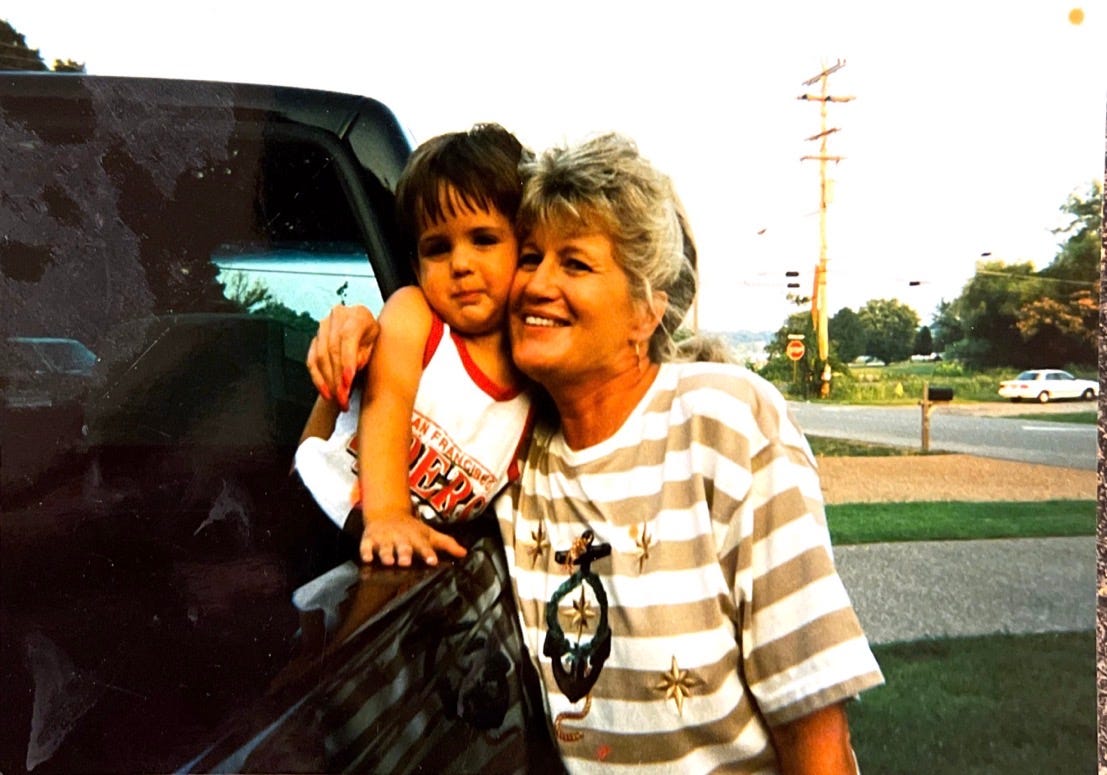
Mimi & Me, age three.
Austin this is beautiful! I am so happy you have grown into such an amazing young man and that you continue to have women who mother you—because we never out grow the need for that!! Libby